Please read the below instruction and review all of the corresponding animations.
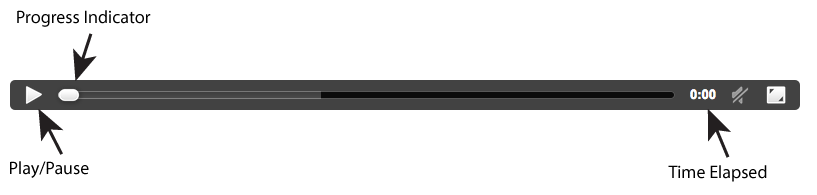
This instruction contains 8 embedded animations. To play each animation, click the Play/Pause button located in the bottom left of the graphic. To pause each animation, click the Play/Pause button located in the bottom left of the graphic. To rewind or review the video, click and drag the Progress Indicator to the left toward the Play/Pause button. To fast forward or advance the animation, click and drag the Progress Indicator to the right toward the Time Elapsed. These animations do not contain sound. A picture of the animation controls is below.
A rotation of an object is a turning of it about a straight line called an axis. 3D objects may be rotated on either the X, Y or Z axis. The straight line about which an object rotates is called the axis of rotation. An object can rotate either positively or negatively about an axis. If you look down the axis of rotation, a positive rotation is counterclockwise and a negative rotation is clockwise.
If an object is rotated around a single axis multiple times, the edge stays in contact with the given axis. If an object is rotated around multiple axes, a single point stays in contact with the origin.
Objects can be rotated about two or more axes in the same manner that they can be rotated about a single axis.
When rotation occurs about a single axis, an entire edge remains in its original position. When rotation occurs about two different axes, only a single pivot point remains in its original position.
93
Objects can be rotated positively (counterclockwise) or negatively (clockwise) about each axis, just like when rotating about a single axis. (Remember the right hand rule!
94
Rotations about two or more axes are not commutative. In other words, the order in which the rotations occur is important. If you switch the order of the rotations, you will not end up with the same result.
You can rotate an object in space as many times as you wish which can result in complex arrow codes.
95
As with single axis rotations, different arrow codes can give you the same result. Two sets of arrow codes that result in the same final orientation of the object are said to be equivalent.
Complex arrow codes can sometimes be reduced to simpler ones.
96